'Moderne' Blocks Of Flats: Difference between revisions
No edit summary |
|||
| (38 intermediate revisions by 3 users not shown) | |||
| Line 1: | Line 1: | ||
[[File:Berthold Lubetkin Highpoint.jpg | Berthold Lubetkin's Highpoint 1 Highgate London]] The 'Moderne' | [[File:Berthold Lubetkin Highpoint.jpg |250px|right|Berthold Lubetkin's Highpoint 1 Highgate London]] The 'Moderne' block of flats arrived in the UK in the 1920s as Britain looked to define a bright new 20th Century after the horrors of the First World War. In this desire, Britain looked to Europe, and the new [[International Moderne]] Movement for inspiration. Built by a new wave of young architects, often refugees from war torn Europe, the new blocks brought crisp clean lines, white stucco walls and minimal detailing. Like Moderne houses, the Moderne blocks of flats developed in a range of styles starting with the simple but powerful [[#'Moderne' Blocks|Moderne]]. Towards the end of the period, the UK developed some wonderfully evocative [[#Streamline Moderne|Streamline Moderne]] blocks of flats with curving lines and windows. Architecture never stands still, and the end of the twenties and thirties brought a new purist approach to design that led to Modernism, (with out the 'e')and eventually the [[Brutalism]] of the 1960's and 1970s. | ||
=='Moderne' Blocks== | =='Moderne' Blocks Of Flats== | ||
[[File:LoveInModerneBlocks-HeathRobinson.jpg |250px|right|‘Romantic Possibilities In Modern Flats’ by William Heath Robinson]] | |||
Like 'Moderne' houses , the first International Moderne blocks were as shocking as they were revolutionary when they arrived in the UK. Blocks like [[Berthold Lubetkin]]'s Highpoint 1 in Highgate, London were unlike anything seen in the UK before. The stark lines, white stuccoed walls, [[Crittall Windows]] and flat roofs were produced reflected the new international aesthetic, but to British sensibilities, they were divisive. Blocks like Frederick Gibberd's Pullman Court, in South London and Ravelston Gardens in Edinburgh are now viewed as national treasures and regularly appear in films and TV dramas depicting the period such as ITV's [[Homes Used In Poirot Episodes | Poirot]]. At the time, they divided the nation. | |||
<gallery mode=packed> | |||
File:Ravelston Gardens.jpg| Ravelston Gardens, Edinburgh. Neal & Hurd 1935-36 | |||
File:PullmanCourt2.JPG| Pullman Court, South London, [[Frederick Gibberd]] 1933 | |||
</gallery> | </gallery> | ||
The 'Moderne' style is still influential, and you can see echoes of it in many | The 'Moderne' style is still influential, and you can see echoes of it in many new blocks of flats being built today. However, in the 1930s it didn't take long for the mood to change. As with houses, a more restrained version was appearing for those suburbs not ready for revolution. | ||
==Restrained Moderne== | ==Restrained Moderne== | ||
As with [['Moderne' Houses]] it became clear that the public was held back by the kind of nostalgia the Daily Mail had described in its review of the Paris show and a new 'restrained' hybrid style of flats emerged. These were necessarily a compromise, a style assembled for people who were still seduced by the clean lines of the Moderne movement but who were slightly put off by the brutal nature of the flat-roofs. | |||
The curved windows and horizontal lines remained but with hipped roofs, bricks and tiles. | The curved windows and horizontal lines remained but with hipped roofs, bricks and tiles. These blocks drifted back towards the 'mansion blocks' of the late Victorian period. | ||
==Streamline Moderne== | ==Streamline Moderne== | ||
Predominantly a US phenomenon, Streamline Moderne evolved as a more formulaic architectural style that chose cars, trains and boats as its inspiration. The building style was meant to capture the speed and exhilaration of 1930s travel and its highpoint was skyscrapers like the Chrysler Building in New York. In the UK, the theatricality of Streamline was frowned upon for houses but it did lend itself to blocks of flats like Hartington Court or Florin Court, in Clerkenwell - one of the [[Homes Used In Poirot Episodes | properties used in episodes of Poirot]] - as well as hotels like the Midland in Morecambe and factories with US owners such as the Hoover and Firestone Buildings in West London. | Predominantly a US phenomenon, Streamline Moderne evolved as a more formulaic architectural style that chose cars, trains and boats as its inspiration. The building style was meant to capture the speed and exhilaration of 1930s travel and its highpoint was skyscrapers like the Chrysler Building in New York. In the UK, the theatricality of Streamline was frowned upon for houses but it did lend itself to blocks of flats like Hartington Court or Florin Court, in Clerkenwell - one of the [[Homes Used In Poirot Episodes | properties used in episodes of Poirot]] - as well as hotels like the Midland in Morecambe and factories with US owners such as the Hoover and Firestone Buildings in West London. | ||
<gallery> | <gallery mode=packed> | ||
File:Hartington court.jpg| Hartington Court, Chiswick London | File:Hartington court.jpg| Hartington Court, Chiswick London | ||
File:StreamlineModerneFlats.jpg | Flats in South London | File:StreamlineModerneFlats.jpg | Flats in South London | ||
File:Florin Court.jpg | Florin Court, Clerkenwell | File:Florin Court.jpg | Florin Court, Clerkenwell | ||
File:Ship Apartments-Paris.jpg | The Ship Apartments in Paris | File:Ship Apartments-Paris.jpg | The Ship Apartments in Paris | ||
File:LichfieldCourt4.jpg| [[Lichfield Court]] Richmond, Surrey | |||
File:FrintonStreamlineFlats.jpg| Beachside flats in Frinton-on-Sea | |||
File:ViceroyCourt-RegentsPark.jpeg|Viceroy Court, Prince Albert Road, Regent’s Park, by Marshall & Tweedy, 1938. | |||
</gallery> | </gallery> | ||
==Modern or Modernist Blocks== | |||
<gallery mode=nolines> | |||
File:Berthold Lubetkin Highpoint.jpg | Berthold Lubetkin's [[Highpoint 1]] Highgate London | |||
File:IsokonPhoto2.jpg | The Isokon Building, Hampstead London by Berthold Lubetkin's [[Tekton]] | |||
File:SulkinHouse-DenysLasdun.jpeg|Sulkin House by Denys Lasdun | |||
</gallery> | |||
==See Also In Chimni== | ==See Also In Chimni== | ||
Chimni Wiki Page [[Flats In A Low Rise Block]] | |||
Chimni Wiki Page [[Is My House 'Art Deco'?]] | |||
Chimni Wiki Page [[Homes Used In Poirot Episodes]] | |||
==Other Interesting Web Sites== | ==Other Interesting Web Sites== | ||
[http://londondecoflats.co.uk/estates/ Art Deco Flats] | |||
[http://www.flickr.com/groups/modernist-houses/ FlickrGroup: Modernist Houses Of The 1930s] | [http://www.flickr.com/groups/modernist-houses/ FlickrGroup: Modernist Houses Of The 1930s] | ||
| Line 65: | Line 69: | ||
[http://www.architecture.com/LibraryDrawingsAndPhotographs/Exhibitionsandloans/ArtDecoTriumphant/ArtDecoTriumphant.aspx RIBA Library 'Art Deco Triumphant'] | [http://www.architecture.com/LibraryDrawingsAndPhotographs/Exhibitionsandloans/ArtDecoTriumphant/ArtDecoTriumphant.aspx RIBA Library 'Art Deco Triumphant'] | ||
Pinterest Board - http://www.pinterest.com/benwillmore/streamline-moderne-design/ Pinterest Board: Streamline Moderne] | |||
Pinterest Board - Deco & Modernism - http://www.pinterest.com/MargaretDier/deco-and-modernism/ | |||
==Books We Liked== | ==Books We Liked== | ||
Latest revision as of 19:11, 13 March 2023

The 'Moderne' block of flats arrived in the UK in the 1920s as Britain looked to define a bright new 20th Century after the horrors of the First World War. In this desire, Britain looked to Europe, and the new International Moderne Movement for inspiration. Built by a new wave of young architects, often refugees from war torn Europe, the new blocks brought crisp clean lines, white stucco walls and minimal detailing. Like Moderne houses, the Moderne blocks of flats developed in a range of styles starting with the simple but powerful Moderne. Towards the end of the period, the UK developed some wonderfully evocative Streamline Moderne blocks of flats with curving lines and windows. Architecture never stands still, and the end of the twenties and thirties brought a new purist approach to design that led to Modernism, (with out the 'e')and eventually the Brutalism of the 1960's and 1970s.
'Moderne' Blocks Of Flats[edit]

Like 'Moderne' houses , the first International Moderne blocks were as shocking as they were revolutionary when they arrived in the UK. Blocks like Berthold Lubetkin's Highpoint 1 in Highgate, London were unlike anything seen in the UK before. The stark lines, white stuccoed walls, Crittall Windows and flat roofs were produced reflected the new international aesthetic, but to British sensibilities, they were divisive. Blocks like Frederick Gibberd's Pullman Court, in South London and Ravelston Gardens in Edinburgh are now viewed as national treasures and regularly appear in films and TV dramas depicting the period such as ITV's Poirot. At the time, they divided the nation.
-

Ravelston Gardens, Edinburgh. Neal & Hurd 1935-36
-
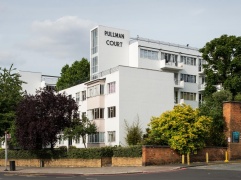
Pullman Court, South London, Frederick Gibberd 1933


The 'Moderne' style is still influential, and you can see echoes of it in many new blocks of flats being built today. However, in the 1930s it didn't take long for the mood to change. As with houses, a more restrained version was appearing for those suburbs not ready for revolution.
Restrained Moderne[edit]
As with 'Moderne' Houses it became clear that the public was held back by the kind of nostalgia the Daily Mail had described in its review of the Paris show and a new 'restrained' hybrid style of flats emerged. These were necessarily a compromise, a style assembled for people who were still seduced by the clean lines of the Moderne movement but who were slightly put off by the brutal nature of the flat-roofs.
The curved windows and horizontal lines remained but with hipped roofs, bricks and tiles. These blocks drifted back towards the 'mansion blocks' of the late Victorian period.
Streamline Moderne[edit]
Predominantly a US phenomenon, Streamline Moderne evolved as a more formulaic architectural style that chose cars, trains and boats as its inspiration. The building style was meant to capture the speed and exhilaration of 1930s travel and its highpoint was skyscrapers like the Chrysler Building in New York. In the UK, the theatricality of Streamline was frowned upon for houses but it did lend itself to blocks of flats like Hartington Court or Florin Court, in Clerkenwell - one of the properties used in episodes of Poirot - as well as hotels like the Midland in Morecambe and factories with US owners such as the Hoover and Firestone Buildings in West London.
-

Hartington Court, Chiswick London
-
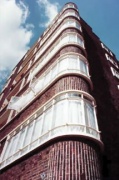
Flats in South London
-

Florin Court, Clerkenwell
-

The Ship Apartments in Paris
-

Lichfield Court Richmond, Surrey
-

Beachside flats in Frinton-on-Sea
-
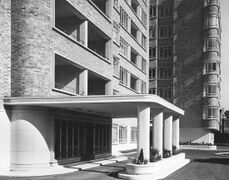
Viceroy Court, Prince Albert Road, Regent’s Park, by Marshall & Tweedy, 1938.


Modern or Modernist Blocks[edit]
-

Berthold Lubetkin's Highpoint 1 Highgate London
-
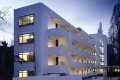
The Isokon Building, Hampstead London by Berthold Lubetkin's Tekton
-

Sulkin House by Denys Lasdun


See Also In Chimni[edit]
Chimni Wiki Page Flats In A Low Rise Block
Chimni Wiki Page Is My House 'Art Deco'?
Chimni Wiki Page Homes Used In Poirot Episodes
Other Interesting Web Sites[edit]
FlickrGroup: Modernist Houses Of The 1930s
An Archive of 'Moderne' Houses in London (with photos
A Schedule of 'Art Deco' Houses in London
Docomomo - Dedicated to The Moderne Movement
RIBA Library 'Art Deco Triumphant'
Pinterest Board - http://www.pinterest.com/benwillmore/streamline-moderne-design/ Pinterest Board: Streamline Moderne]
Pinterest Board - Deco & Modernism - http://www.pinterest.com/MargaretDier/deco-and-modernism/
Books We Liked[edit]
References[edit]
<references />