Is My House 'Art Deco': Difference between revisions
No edit summary |
No edit summary |
||
| Line 2: | Line 2: | ||
==Overview== | ==Overview== | ||
'ArtDeco' was a decorative style sometimes applied to the facades and interiors buildings, but not affecting core structure or design. For the most part these buildings were built in an architectural style called Moderne or if you are being particularly grand [['Moderne' Houses#International Moderne|'International Moderne']]. In America | 'ArtDeco' was a decorative style sometimes applied to the facades and interiors buildings, but not affecting core structure or design. For the most part these buildings were built in an architectural style called Moderne or if you are being particularly grand [['Moderne' Houses#International Moderne|'International Moderne']]. However, many people have begun to use ‘Art Deco’ as a shorthand to describe them. As Professor of Design History Deborah Suggs Ryan says "I don’t use the term Art Deco, which I find deeply problematic. It was invented in 1968 by Bevis Hillier. I dislike the way it’s become a catch all term to describe anything that is modern but doesn’t fit the Modern Movement" | ||
In America the Moderne style was also sometimes called [['Moderne' Houses#Streamline Moderne|Streamline Moderne]] - because the buildings looked like ocean liners and fast trains. Famous British building icons like the Hoover Building or the [http://www.dlwp.com/visit-us/ De La Ware Pavilion] would fit into the Moderne category - as do lots of houses. | |||
Even the perfect Art Deco TV programme - Poirot - needs to be qualified. Series producer Brian Eastman said in a recent interview 'the set was 30s modern, not actually Art Deco, because Agatha Christie had explained in a profile of Poirot that Art Deco was too flamboyant for him'. The houses that commonly get called ArtDeco tend to be [['Moderne' Houses]] (which were typically flat roofed) or [['Moderne' Houses#Restrained Moderne|Restrained Moderne]] style (which have hipped roofs). So your house is most probably built in Moderne style with some Art Deco flourishes! Its still beautiful. | Even the perfect Art Deco TV programme - Poirot - needs to be qualified. Series producer Brian Eastman said in a recent interview 'the set was 30s modern, not actually Art Deco, because Agatha Christie had explained in a profile of Poirot that Art Deco was too flamboyant for him'. The houses that commonly get called ArtDeco tend to be [['Moderne' Houses]] (which were typically flat roofed) or [['Moderne' Houses#Restrained Moderne|Restrained Moderne]] style (which have hipped roofs). So your house is most probably built in Moderne style with some Art Deco flourishes! Its still beautiful. | ||
Revision as of 11:17, 13 December 2019

You may think that this is just a simple question of whether the nice leaded-glass on your front foor front door counts as 'Art Deco', but this is actually one of the thorniest issues in modern architecture! There are lots of references to 'Art Deco Architecture' in books and on the web, but there are many people (including those of us here at Chimni) that don't believe that Art Deco is an architectural style - at least not in the UK.
Overview
'ArtDeco' was a decorative style sometimes applied to the facades and interiors buildings, but not affecting core structure or design. For the most part these buildings were built in an architectural style called Moderne or if you are being particularly grand 'International Moderne'. However, many people have begun to use ‘Art Deco’ as a shorthand to describe them. As Professor of Design History Deborah Suggs Ryan says "I don’t use the term Art Deco, which I find deeply problematic. It was invented in 1968 by Bevis Hillier. I dislike the way it’s become a catch all term to describe anything that is modern but doesn’t fit the Modern Movement"
In America the Moderne style was also sometimes called Streamline Moderne - because the buildings looked like ocean liners and fast trains. Famous British building icons like the Hoover Building or the De La Ware Pavilion would fit into the Moderne category - as do lots of houses.
Even the perfect Art Deco TV programme - Poirot - needs to be qualified. Series producer Brian Eastman said in a recent interview 'the set was 30s modern, not actually Art Deco, because Agatha Christie had explained in a profile of Poirot that Art Deco was too flamboyant for him'. The houses that commonly get called ArtDeco tend to be 'Moderne' Houses (which were typically flat roofed) or Restrained Moderne style (which have hipped roofs). So your house is most probably built in Moderne style with some Art Deco flourishes! Its still beautiful.
-

The Moderne classic 'High & Over' 'Moderne' with no Art Deco influence
-
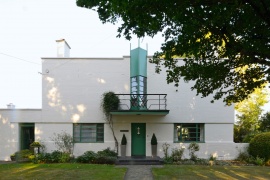
'Wolverton', Silver End, Essex. Thomas S. Tait. 1928.Photo: @Elain540 Moderne with Art Deco flourishes


See Also In Chimni
Chimni Wiki Page: 'Moderne' Houses
ChimniWiki Homes Used In Poirot Episodes
Chimni Wiki Page: 'Moderne' Blocks Of Flats
ChimniWiki Is My House 'Georgian Anglo-Palladian Classical'?
Other Interesting Web Sites
A Schedule of 'Art Deco' Houses in London
RIBA Library 'Art Deco Triumphant'
A Pinterest Board of 1930s House Delights
Books We Liked
References
<references />