Nissen Huts: Difference between revisions
No edit summary |
|||
| Line 6: | Line 6: | ||
Back to the top level of the [[Chimni Home Typology]] | Back to the top level of the [[Chimni Home Typology]] | ||
==History of Nissen Huts== | |||
In April 1916 mining Engineer Major, later Lieutenant Colonel, Peter Norman Nissen of the 29th Company Royal Engineers began investigating hut designs. He developed three prototype semi-circular huts whose shape derived from the drill-shed roof at Queen's University, Kingston, Ontario. After the third prototype was approved the Nissen Hut was put into production in August 1916 with more than 100,000 being produced during the First World War. The great benefit, during the war, and after when there was a desperate shortage of houses, was that the Nissen hut could be packed in a standard army lorry and erected by six men in four hours. | |||
==Examples Of Nissen Hut Houses== | ==Examples Of Nissen Hut Houses== | ||
| Line 18: | Line 19: | ||
File:Nissenhuthouse.jpg|Nissen Hut House at Ashdown Camp, Evesham, WorcestershireNissen Huts | File:Nissenhuthouse.jpg|Nissen Hut House at Ashdown Camp, Evesham, WorcestershireNissen Huts | ||
</gallery> | </gallery> | ||
==The Nissen-Petren Houses== | |||
The Nissen-Petren Houses were a prefabricated housing concept based on the core principles of the Nissen hut, but extending its construction into concrete and other materials. The revolutionary design was based around a roof construction comprising semi-circular steel ribs bolted at both ends to the concrete foundations and using prefabricated concrete end walls. They were part of a wider experiment with prefabricated houses after WWI because of the need for housing was hampered by a lack of manpower to build any. The search for new cheaper and labour-efficient methods was on | |||
Once the roof of weatherproofed steel sheeting was on, the interior could be constructed in any weather. The houses were designed to accommodate a living room, kitchen and scullery, bathroom with a separate toilet and a bedroom on the ground floor with two further bedrooms on the first floor. It was estimated that each house could be built for £350, producing a significant cost saving of £100 per house over traditional construction techniques. | |||
The main batch of Nissen-Petren houses were in Yeovil and Camel in Somerset. The Somerset houses were designed by John Petter and Percy J Warren, a local architectural practice appointed Borough Architects to Yeovil Town Council in 1911. The obvious debt to Nissen was acknowledged in their creation of the Nissen-Petren name for their company. | |||
==Recent Nissen Hut Conversions== | ==Recent Nissen Hut Conversions== | ||
| Line 36: | Line 44: | ||
http://www.invisiblethemepark.com/2013/02/quonset-hut-house-cutaway-1946/ | http://www.invisiblethemepark.com/2013/02/quonset-hut-house-cutaway-1946/ | ||
https://municipaldreams.wordpress.com/2018/04/24/nissen-petren-houses-not-obnoxious-and-the-people-would-be-delighted-to-pay-an-economic-rent/ | |||
http://www.yeovilhistory.info/nissen-petren.htm | |||
[[Category:Building Types]] | [[Category:Building Types]] | ||
[[Category:Homes In Other Buildings]] | [[Category:Homes In Other Buildings]] | ||
[[Category:Army & Wartime Buildings]] | [[Category:Army & Wartime Buildings]] | ||
Revision as of 20:54, 8 April 2021

Nissen Huts were invented by..
Back up one level to Military & Wartime Buildings
Back to the top level of the Chimni Home Typology
History of Nissen Huts
In April 1916 mining Engineer Major, later Lieutenant Colonel, Peter Norman Nissen of the 29th Company Royal Engineers began investigating hut designs. He developed three prototype semi-circular huts whose shape derived from the drill-shed roof at Queen's University, Kingston, Ontario. After the third prototype was approved the Nissen Hut was put into production in August 1916 with more than 100,000 being produced during the First World War. The great benefit, during the war, and after when there was a desperate shortage of houses, was that the Nissen hut could be packed in a standard army lorry and erected by six men in four hours.
Examples Of Nissen Hut Houses
The Nissen huts were essentially large scale versions of air-raid shelters with similar corrugated steel roofs. Thousands of people in east Lodnon were moved into the temporary homes during the late 1940s and 1950s but after the city was rebuilt and the economy prospered they started to become empty by the late 1960s
-
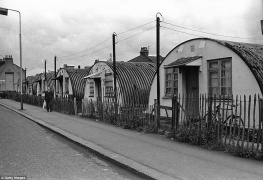
Temporary houses built in East London during WWII to house people displaced by bombing.
-
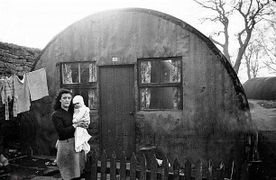
Duddington Camp, Edinburgh. Built as an army camp but still in use as housing in 1954
-
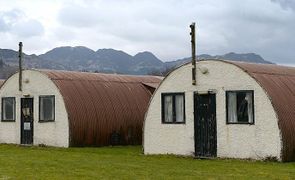
Cultybraggan Camp, Perthshire was built to house prisoners of war, but is being converted into housing.
-
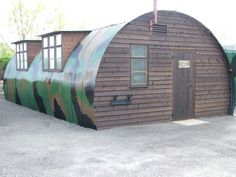
Nissen Hut House at Ashdown Camp, Evesham, WorcestershireNissen Huts


The Nissen-Petren Houses
The Nissen-Petren Houses were a prefabricated housing concept based on the core principles of the Nissen hut, but extending its construction into concrete and other materials. The revolutionary design was based around a roof construction comprising semi-circular steel ribs bolted at both ends to the concrete foundations and using prefabricated concrete end walls. They were part of a wider experiment with prefabricated houses after WWI because of the need for housing was hampered by a lack of manpower to build any. The search for new cheaper and labour-efficient methods was on
Once the roof of weatherproofed steel sheeting was on, the interior could be constructed in any weather. The houses were designed to accommodate a living room, kitchen and scullery, bathroom with a separate toilet and a bedroom on the ground floor with two further bedrooms on the first floor. It was estimated that each house could be built for £350, producing a significant cost saving of £100 per house over traditional construction techniques.
The main batch of Nissen-Petren houses were in Yeovil and Camel in Somerset. The Somerset houses were designed by John Petter and Percy J Warren, a local architectural practice appointed Borough Architects to Yeovil Town Council in 1911. The obvious debt to Nissen was acknowledged in their creation of the Nissen-Petren name for their company.
Recent Nissen Hut Conversions
-
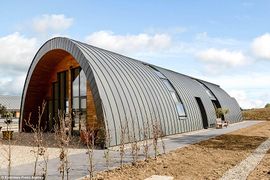
A former light aircraft hangar in rural Essex transformed into a 5 bed home that featured on C4's 'Grand Designs'
-
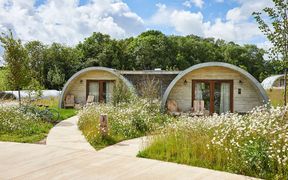
Holiday chalets at Soho Farmhouse, Wiltshire known as their ‘Piglet Huts’.


See Also In Chimni
Other Interesting Sites
http://nissenbuildings.com/History.htm
http://web.mst.edu/~rogersda/umrcourses/ge342/quonset_huts-revised.pdf
http://www.invisiblethemepark.com/2013/02/quonset-hut-house-cutaway-1946/