'Moderne' Houses

'Moderne' houses arrived in Britain after the First World War bringing with them a revolution in house design. The government-sponsored drive to mass produce 'Homes For Heroes', for returning soldiers, led to a desire to industrialise the process of housebuilding. Britain looked to Europe, and the new International Modern Movement for inspiration. For the UK homeowner, 'Moderne' houses (and some amazing Poirot episodes) were the result. Moderne houses in the UK tend to fall into one of three kinds Moderne, Restrained Moderne and Hollywood Moderne but are all based on a style that started as 'International Moderne'.
International Moderne

In 1925 there was an exhibition in Paris that was the 'Ideal Home' of its day. Called the 'Exposition Internationale des Arts Decoratifs et Industriels Modernes', its name gave the world the phrase 'Art Deco'. More importantly, it introduced a new architectural style - 'International Moderne' that would sweep the world, and arrive in the suburbs of British cities. This style rejected excessive decoration and ornamentation. It was characterised by straight lines, geometrical forms and cantilevered structures. The most important element was the extensive use of glass to 'capture the sun', with huge metal framed windows and screen walls. It was a housing style pioneered by influential European design schools like the Bauhaus and by architects Ludwig Mies van de Rohe, Le Corbusier and Walter Gropius.
While many in the UK were thrilled, there were doubters. The Daily Mail remarked “...unquestionably every Englishman who visits the pavilions will ask himself whether he would care to live among such impeccable surroundings from which cosiness is markedly absent… our Englishman, mindful of fireside joys, of capacious easy chairs, will, perhaps, admire, then turn aside and leave the exhibition and its excesses to the French”. They were proved wrong, as 'Moderne' houses soon began arriving in Britain.
'Moderne' Houses

When 'Moderne' houses arrived in the UK they were as shocking as they were revolutionary. The stark lines, white stuccoed walls, Crittall Windows and flat roofs of the houses that were produced reflected the new international aesthetic, but to British sensibilities, they were divisive.
Often wrongly referred to as Art Deco houses (See 'Is My House 'Art Deco'?), or lumped into the catch-all description of '1930s Houses', these buildings appeared in the UK in the early 1920s and were still being built by the late 1940s. At the Ideal Home Exhibition of 1934, the 'Village of Tomorrow' was comprised of houses built exclusively in the 'International Moderne' style. These houses heralded a completely new way of living, with their flat roofs described as ‘a whole floor of extra space, and delightful means to revel in the out-of-doors... to take your meals in the open, and... sleep al fresco’<ref>Ideal Home Catalogue (1934), p. 127 </ref>. Diagrams were produced showing how hipped roofs blocked light from your neighbours across the road. This style was rolling out across Europe with examples like Vila Tugendhat in Czechoslovia already causing waves.
However, the new style was not universally accepted in the UK and there were concerns that our weather made flat roofs and sun decks an impractical solution. Sometimes called 'sun-trap' houses, they were very popular on the English south coast Riviera. Moderne houses were satirised as '20th Century Functional' by the great Osbert Lancaster in his 1938 book Pillar To Post,<ref>Pillar To Post, Osbert Lancaster, 1938</ref> which poked affectionate fun at the various building styles emerging in the UK after the war.
However, as well as wonderful estates of modest family houses such as Park Avenue, Ruislip and Silver End in Braintree, the period also produced renowned modernist detached houses for the rich and famous by architects such as Gropius, Lubetkin and Wells Coates. These were always more likely to be preserved. Now beautifully restored, houses like 'High & Over' in Bucks, and 'High Cross' in Devon regularly appear in films and TV dramas depicting the period such as ITV's Poirot and Agatha Christie.
-

Semi-detached Moderne house in Nuneaton, Warwickshire.
-

A striking detached Moderne house.
-

Killowat House, Bath by Mollie Taylor
-

A 'Moderne' Suntrap house
-

High Cross House, Devon. One of the classic 'Moderne' houses.
-

The exquisite 'High & Over' in Amersham, Bucks.


The 'Moderne' style is still influential, and you can see echoes of it in many houses being built today. However, in the 1930s it didn't take long for the mood to change. At the 1935 Ideal Home Exhibition, the following year, there was only one house in the pure 'Moderne style'. A new restrained version was appearing.
Restrained Moderne

It became clear that the public was held back by the kind of nostalgia the Daily Mail had described in its review of the Paris show. British housebuilders responded and a new 'restrained' hybrid style emerged. It was a style assembled for people who were still seduced by the clean lines of the Moderne movement but who were slightly put off by the brutal nature of the flat-roofs.
The curved windows and horizontal lines remained but with hipped roofs, bricks and tiles. Restrained Moderne was a uniquely British fudge with the lower lines and horizontal mullioned windows offset by a nice safe roof 'like your mother had'. Arguably, Restrained Moderne is more suited to the British climate, where sun-terraces in suburban streets were always going to be a laughable extravagance.
By the end of the 1930s consumers had also begun to reject the aesthetic simplicity of the Moderne movement. They began to ask for decoration around doors and windows. Leaded lights with art deco 'sunburst' patterns appeared, doorways and gates got style, and a safe suburban style was created. Perfectly suited for mass production of the now popular semi-detached houses, the next decade saw almost 4 million of these beautifully recognisable family homes being built.
-

Semi-detached Restrained Moderne houses in Richmond, Surrey.
-

A detached Restrained Moderne house, showing clean lines, but tiled roof.
-
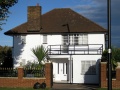
Restrained Moderne in Enfield


Hollywood Moderne
There is some debate about whether a separate style called Hollywood Moderne exists for houses in the UK. There was clearly a phenomenon of larger Restrained Moderne houses built in the late 1930s that adopted the styling of Hollywood Boulevard - sweeping driveways, green or blue pantiles on the roof, and balconies with ArtDeco flourishes. Hollywood Moderne was a style that lent itself to larger, detached houses with a nouveau-riche pretension to movie grandeur. Favoured by TV celebrities they enriched the newly expensive suburbs and clustered around golf courses.
Hollywood Moderne should be treated as distinct for the parallel evolution in Moderne architecture that hankered after the speed and streamlining of the available international travel.
Streamline Moderne
Predominantly a US phenomenon, Streamline Moderne evolved as a more formulaic architectural style that chose cars, trains and boats as its inspiration. The building styles were meant to capture the speed and exhilaration of 1930s travel and its highpoint was skyscrapers like the Chrysler Building in New York. In the UK, the theatricality of Streamline was frowned upon for houses but it did lend itself to blocks of flats and factories with US owners such as the Hoover Firestone Buildings in West London.
-

Hartington Court, Chiswick London
-
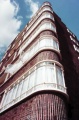
Flats in South London
-
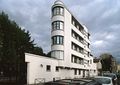
The Ship Apartments in Paris
-

The Midland Hotel Morecambe
-

Florin Court, Clerkenwell


Desert Moderne
Desert Modernism was another wholly US movement (mainly because we don't have deserts in the UK). The spiritual home is Palm Springs, California. The desert modernist style emerged in the 1920s but was widely adopted in the late 1950s, when the Alexander tract of more than 2,000 homes in Palm Springs – said to be the US’s biggest modernist housing estate – took shape.
Architects including Richard Neutra, John Lautner and Donald Wexler flocked to the town to carve their niche with this new strain of modernist architecture that was inspired by local materials, and the earthy colours and sheer scale of the surrounding desert and San Jacinto mountains.
-

Sky Ridge Road, Palm Springs, California

See Also In Chimni
ChimniWiki Is My House 'Art Deco'?
Other Interesting Web Sites
FlickrGroup: Modernist Houses Of The 1930s
An Archive of 'Moderne' Houses in London (with photos
A Schedule of 'Art Deco' Houses in London
Docomomo - Dedicated to The Moderne Movement
RIBA Library 'Art Deco Triumphant'
References
<references />